Hatlab-photo-research

Research

Our Research Projects

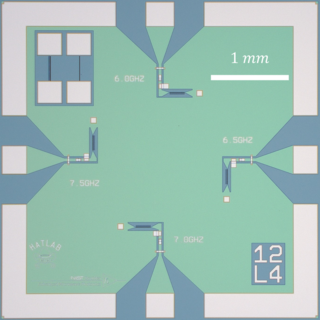
  • Aluminum housing for a 6-qubit

    The aluminum housing for a 6-qubit, 2 module processor design set on the still stage one of our new dilution refrigerators for ambience.

  • Typical packages in the lab

    From top left: an assembled experiment in its light tight and cryoperm shielding, a four qubit ‘module’, an experimental PCB-less amplifier mount, another four-qubit module,

  • Sample housings

    Sample housings in front of one of our new cryostats.

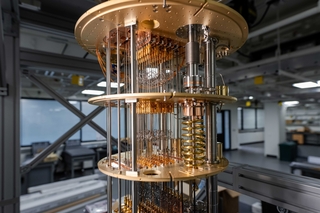
  • New crystat

    One of our new crystats; note the custom-built, modular line mounting system.

Quantum information is a rapidly growing theoretical and experimental field which seeks to harness the complexity and coherence of quantum bits to address challenges in computation and the simulation of complex quantum systems.  Our group research focuses on the use of superconducting microwave circuits as a quantum information platform.  In particular, we will focus on the use of microwave photons as quantum information carriers.  We will develop techniques to create, manipulate, and measure microwave light and use it to entangle larger quantum systems.


Efficient amplification of microwave signals is fundamental to this research, as it allows us to faithfully decode and record information contained in pulses of microwave light.  We will develop superconducting parametric amplifiers with the goal of achieving performance very close to the quantum limit, where the amplifier itself can perform unitary operations on its input fields.  This allows us to create new and complex measurement operations, which in turn will be used to entangle remote quantum bits and detect and remedy errors in quantum registers.

The following highlights some of our recent work:

MODQ

Modular Quantum Machines 

We investigate parametrically coupled modular superconducting architectures. Low fabrication yield and non-repeatability is one of the major problems plaguing superconducting circuit scale-up. Modularity circumvents this by allowing problematic parts to be replaceable, however introduces multiple engineering challenges. This project focuses on engineering a modular 6-Transmon, 2-SNAIL unit cell as a scalable building block. We tune Transmon–SNAIL and SNAIL–SNAIL hybridization to realize fast, high-fidelity gates while suppressing parasitic couplings and mode crowding. We study cross-Kerr interactions, higher-order mixing processes, and spectator-induced errors, and explore limits of parametric couplings on an academic scale. By linking these modules, we aim to establish a practical route toward large-scale, fault-tolerant superconducting quantum processors.

Hatlab-Research-Novel-Couples&Parametric

Novel Couples & Parametric Speed Limits

The state of a qubit can be controlled via nonlinear resonances we refer to as parametric processes. These utilize higher-order Hamiltonian terms to upconvert multiple, low-frequency drive photons to match various resonance conditions. For example, we have recently demonstrated 99.9% fidelity single-qubit gates utilizing the “subharmonic” transition at one-third of a qubit’s resonant frequency. We can also utilize these parametric processes in larger systems by driving a mutually connected coupler to perform single- and multi-qubit gates. We have found the fidelity of such gates is in part limited by a seemingly universal drive strength ($\eta$) threshold resulting from strong hybridization of the coupler eigenmodes in the driven frame. An ongoing area of research in the group is identifying how this threshold depends on crucial circuit parameters as well as how to best design the next generation of qubits and couplers to take advantage of increased thresholds for faster parametric gates.

Hatlab-Novel-Readout

Novel readout

Higher qubit readout fidelities are key for the future of error-correction and fault-tolerant quantum computers. Although high fidelities are achievable with standard techniques such as dispersive readout, we explore other readout modalities that are likely to perform better with careful engineering.
For example, the superconducting Nonlinear Asymmetric Inductive eLement (SNAIL) can be used to implement novel longitudinal QND readout of transverse qubit component using parametric processes. One can generate three-wave mixing based parametric gain and conversion interaction between a SNAIL and qubit by driving the SNAIL at the difference and sum of the qubit and SNAIL frequencies respectively. Matching the rates of these two processes leads to an effective longitudinal coupling between SNAIL and the qubit’s transverse component. This interaction creates a displaced coherent state in the SNAIL whose displacement depends on the qubit transverse component, creating a longitudinal readout of the qubit in the XY plane, with the axis of measurement controlled by the phase of the parametric drives. In principle, longitudinal readout can distinguish qubit states faster than dispersive readout, a key advantage when qubit lifetimes
Another alternative readout scheme is the use of two superconducting parametric amplifiers configured as an interferometer. Interferometers in general are ubiquitous in precision metrology, as they can reduce the effective noise of a measurement. In superconducting circuits, interferometric readout could achieve so-called Heisenberg scaling of phase measurement, enabling high-fidelity readout with much smaller readout pulses. This is critical for existing superconducting qubit designs such as the transmon, which exhibit unwanted leakage or ionization effects under strong measurement pulses.

Hatlab-Practical-Amps

Practical Amps

Quantum-limited parametric amplifiers are necessary to ensure fast, high fidelity readout of quantum systems. An optimized amplifier design (or, “practical amplifier”) can depend on the size or complexity of the quantum system. For academic lab settings, which have few qubit systems at most and readout frequencies which can be difficult to predict due to fabrication uncertainty, amplifier tunability and medium pump powers are more favorable than extremely broadband gain at one specific operating point. For industry settings with larger quantum systems (hundreds or thousands of qubits), extremely broadband amplifiers with high saturation powers are required. Our work, which focuses on resonant-based Josephson parametric amplifiers (JPAs) using arrays of rf-SQUIDs, aims to design and build amplifiers which (1) are maximally tunable and easily used in academic lab settings with few qubit systems and (2) can be built upon to develop broadband, high saturation power amplifiers to allow for simultaneous readout of larger qubit systems.

Funding Agencies

Funding Agencies-Logos